$49
Buy Now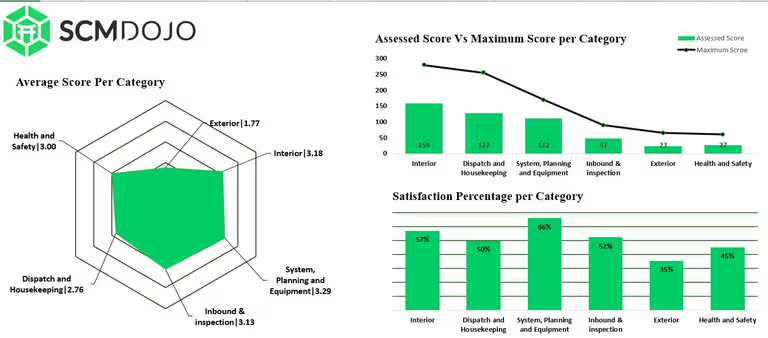
How can you determine whether your warehouse is operating at a satisfactory level? This warehouse audit tool, or Warehouse Audit Checklist, empowers you to pinpoint areas that require enhancement and gauge the performance of your warehouse.
What is a Warehouse Self-Assessment Audit?
A Warehouse Self-Assessment Audit is a systematic evaluation of your warehouse’s operations to identify strengths, weaknesses, and areas for improvement. It’s a crucial tool for ensuring optimal efficiency, safety, and productivity within your warehouse. By conducting regular self-assessments, you can proactively address potential issues, enhance operational processes, and maintain high standards of performance.
This Self-Assessment Warehouse Audit Tool also:
- Encourages employee involvement and responsibility in enhancing warehouse operations.
- Promotes staff reflection on their roles and contributions to essential warehouse processes.
- Provides an avenue for staff to view and reflect on their peers’ contributions assessment.
- Centers around cultivating employees’ judgment skills.
This tool has been developed as a result of a research project with Manchester Business School.
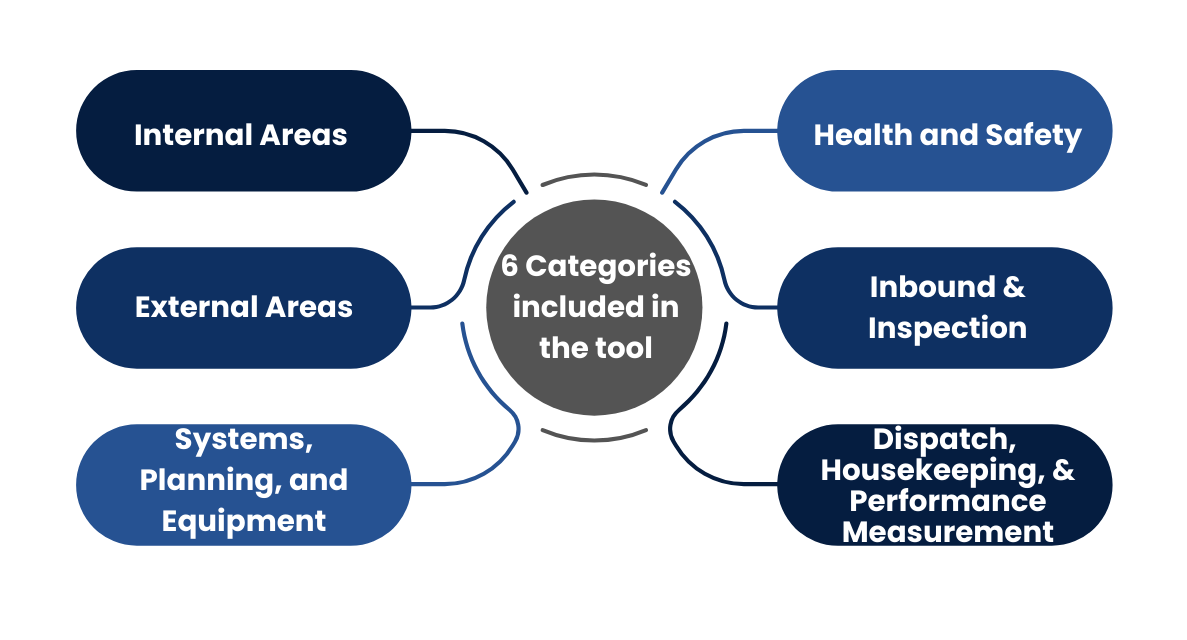
This comprehensive and thoroughly tested Warehouse Audit tool comprises 184 questions categorized as follows:
As a manager or staff member, it’s crucial to have awareness of warehouse activities and processes that require planning and control, encompassing:
“Inbound flow handling, product-to-location assignment, product storage, order-to-stock location-allocation, order batching and release, order picking, packing, value-added logistics activities, and shipment (Ackerman, 1980).”
6 Categories Included in This Warehouse Tool
This warehouse audit tool comprehensively examines the characteristics (indicators) and dimensions of warehouse management across six key areas:
- Internal Areas – Encompassing security checks, safety briefings, floor plans, ventilation, and more.
- External Areas – Covering aspects such as signboards, routes, lighting, parking, and more.
- Systems, Planning, and Equipment – Encompassing IT systems, mechanical handling equipment, key warehouse processes, goods movement, vehicle booking systems, and vehicle scheduling.
- Health and Safety – Addressing internal and external health and safety measures, staff awareness, and more.
- Inbound & Inspection – Focusing on non-conformance in product and packaging, as well as the scheduling of vehicle arrivals.
- Dispatch, Housekeeping, and Performance Measurement – Encompassing picking, warehouse performance management, training, shift allocation, employee utilization, and more.
For each category, select one of the five choices on the Likert scale. If “N/A” is selected, it will not be factored into the total score. Upon completing the Warehouse Audit Checklist, you will receive three graphs.
Over the past decade, there has been a noticeable rise in the complexity of warehouse operations. This complexity is evident in the adoption of advanced IT tools within warehouses and distribution centers (DCs). Consequently, there arises a requirement for a comprehensive warehouse audit program and warehouse audit plan to evaluate this intricacy and uncover potential blind spots.
Ultimately, the primary purpose of the aforementioned categories and the questions included in this warehouse audit tool is to steer you toward the adoption of best practices in warehousing operations.
Additional Tools to Improve Logistics Performance

- Best Warehouse Safety Audit Tool to Improve Safety Performance and reduce accidents and injuries in the Warehouse environment.

- Materials Management Competencies Assessment to improve the performance of the team.

- Inventory Optimization Tool in Excel that will identify E&O, recalculate Safety Stock, identify changes in Made-to-Stock, Made-to-Order, and redo the whole ABC analysis and more in minutes & hours rather than days.
Access our Best Practices on our Website!

Make vs Buy Analysis Real-Life Excel Model
Deciding whether to manufacture in-house or outsource a product or service is one of the most critical decisions a business can make. SCMDOJO’s Make vs Buy Analysis Tool is designed to provide a comprehensive, data-driven framework to evaluate both quantitative costs and qualitative factors, ensuring your organization chooses the path of maximum value and minimum

Spend Analytics Tool
The Spend Analytics Tool Built the Way Procurement Consultants Actually Work Stop building spend reports from scratch every quarter. This plug-and-play Excel template gives you a fully structured, dashboard-ready spend analytics tool — supplier breakdown, category analysis, regional spend, OTD KPIs, and payment terms intelligence — all from a single data paste. What is Spend
Logistics Operations Risk Assessment
At SCMDOJO, we understand the complexities of logistics risk management, which is why we have designed a Comprehensive Logistics Operations Risk Assessment Template—a structured and insightful tool that helps businesses identify, evaluate, and mitigate key risks across all levels of logistics operations. In today’s fast-paced supply chain environment, logistics operations are exposed to a wide
Procurement Risk Assessment
Why do you need Procurement Risk Assessment? Procurement is one of the most critical functions in any organization, directly impacting cost efficiency, supplier performance, compliance, and overall supply chain stability. However, procurement operations are constantly exposed to risks—ranging from supplier failures, financial mismanagement, contract disputes, regulatory compliance challenges, and technology failures to cybersecurity threats. At
Ratings and Reviews
What's your experience? We'd love to know!
Write a ReviewNo reviews found.